%20(5)%20logo.png)
Quebec at a Glance
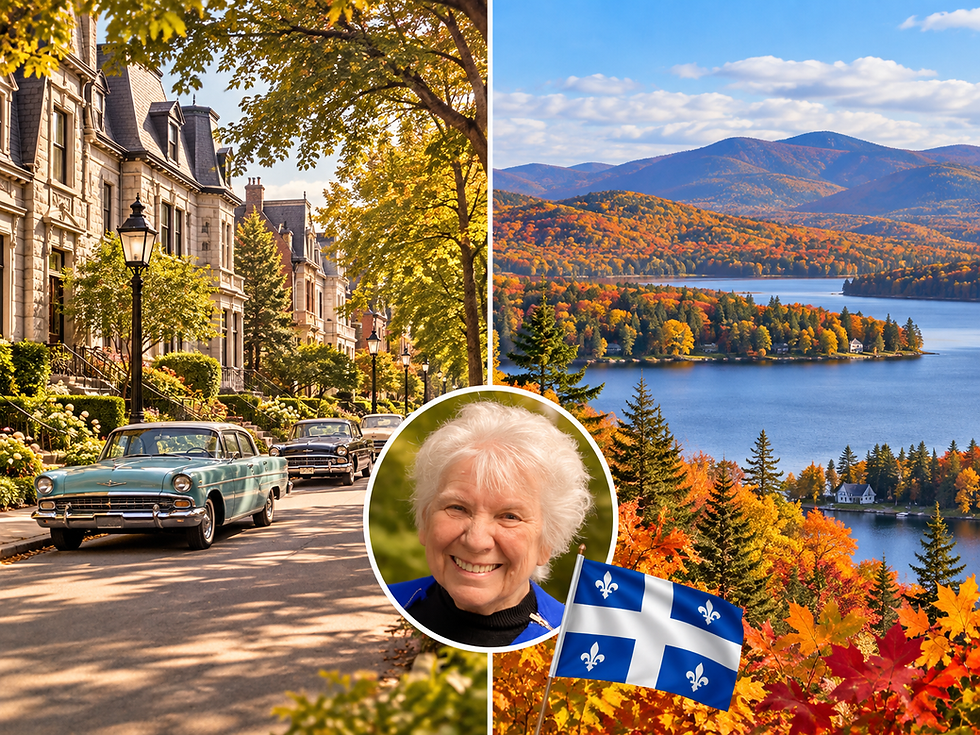
Quebec occupies an enormous part of eastern Canada, stretching from the heavily populated St. Lawrence River corridor northward through vast forests, lakes and rivers toward the Arctic. At roughly 1.5 million square kilometres, it is Canada’s largest province by area and, when the territories are included, second only to Nunavut. Its size is easy to underestimate when most of us picture Quebec through Montréal, Québec City and the communities along the St. Lawrence, because much of the province extends far beyond the areas most Canadians ever see.
Quebec’s flag, the Fleurdelisé, is one of Canada’s most recognizable provincial flags, with a white cross and four white fleurs-de-lis set against a blue background. Adopted in 1948, it reflects the province’s French heritage and the strong sense of identity that has shaped Quebec for generations.
Yet geography and symbols only begin to explain the province, because travel through Quebec for any distance and it becomes very clear that there is no single version of it.
Quebec — Many Worlds, One Province
Quebec is difficult to describe in a few neat paragraphs because there isn't just one Quebec.
Travel across the province, and the personality changes with the landscape. Go far enough north, and you enter a vast world of boreal forest, rivers, hydroelectric projects and eventually tundra — lands that have been home to Cree, Inuit and other Indigenous peoples for thousands of years. Communities are separated by distances that make our idea of “just down the road” rather amusing. Life here has been shaped by weather, water, hunting, fishing, mining and the enormous northern landscape itself.
Come south, and another Quebec begins to appear.
Along the St. Lawrence are old towns, farms and villages where church steeples still rise above the landscape. Much of Quebec's early French-speaking culture grew along this river. The land, the parish, the family and the seasons shaped daily life for generations. Even today, drive the smaller roads rather than the highway, and you can feel some of that older rhythm.
Saguenay–Lac-Saint-Jean — Big Land, Big Personality
Head northeast from Québec City and the land seems to open up around you.
The Saguenay Fjord cuts dramatically through the landscape, while enormous Lac Saint-Jean feels almost like an inland sea. This is a region of forests, farms, blueberries, cold winters, and people with a reputation for being fiercely proud of where they come from.
And naturally, it has its own food.
The famous tourtière du Lac-Saint-Jean is not quite the small meat pie many Canadians picture when they hear “tourtière.” Traditionally, it is a substantial, deep dish filled with meat and potatoes and cooked slowly for hours — the sort of meal designed for a table full of hungry people.
Then there are the blueberries. Lac-Saint-Jean's wild blueberries are such a part of regional identity that people from the area have long been affectionately nicknamed Bleuets.
There is something rather wonderful about a place that can turn a tiny berry into part of its identity.
Charlevoix — Where Mountains Meet the River
Follow the St. Lawrence northeast from Québec City, and you enter Charlevoix, where mountains seem to tumble toward the river.
The scenery is spectacular, but Charlevoix has also become one of Quebec's great food regions. Farms, cheesemakers, bakeries, cider makers, growers and small producers have helped create a culture where the person who raised, grew or made your food may live only a few kilometres away.
This isn't today's fashionable “farm-to-table” dining. In many Quebec communities, knowing where food came from was normal long before anyone invented a marketing phrase for it.
Perhaps that is one reason Quebec does food so well. Tradition hasn't prevented experimentation. It has given cooks something solid to experiment from.
Gaspésie — Quebec Turns Toward the Sea
Keep following the St. Lawrence, and eventually the river becomes the Gulf, the mountains rise beside the water, and Quebec begins to feel distinctly maritime.
Welcome to Gaspésie.
Fishing communities, forests, cliffs and small coastal villages give the Gaspé Peninsula a personality quite different from Montréal or the agricultural heartland.
Here the food naturally turns toward the sea — lobster, crab, shrimp and fish — but the region's cooking also reflects generations of families who learned to make wonderful meals from what was locally available.
And then, at the far eastern end, there is Percé Rock rising out of the Gulf — one of those unmistakable Canadian landscapes that somehow looks even more improbable when you see it in person.
Gaspésie reminds us of something easy to forget when we picture Quebec as Montréal cafés and old stone buildings:
Québec City — Old World, Still Very Much Alive
And then there is Québec City, which somehow manages to be both a modern provincial capital and a place where turning a corner can make you feel you've wandered into Europe.
Stone buildings, narrow streets, steep hills, cafés, history everywhere — and winter treated less as an inconvenience than something one learns how to live with.
Food here can move effortlessly from old Québécois dishes to some remarkably sophisticated cooking. It is part of a larger Quebec pattern: respect the tradition, but don't be afraid to do something new with it.
Montréal — Everyone Brought Something to the Table
And then comes Montréal.
Montréal has never been just one thing. French, English, Jewish, Irish, Italian, Greek, Portuguese, Haitian, Lebanese, and many other communities have all left fingerprints on the city.
The result isn't a tidy blend. It is more like a wonderful patchwork quilt in which the individual pieces are still visible.
You can hear it in the language, see it in the neighbourhoods — and taste it in the food.
I have eaten in many, many restaurants in Quebec over the years, and I honestly cannot remember finding a bad one. From a smoked-meat sandwich at the old Ben's Delicatessen to an elegant meal in Old Montréal, the range is extraordinary.
French cooking sits comfortably beside Jewish deli food, Québécois comfort food, Italian, Greek, Lebanese, Vietnamese, Haitian, and cuisines from virtually everywhere else.
And perhaps that says something important about Quebec.
Food here isn't just for fuel. There is a respect for how something tastes, how it is prepared, and how it is enjoyed.
You don't have to spend a fortune, either. A bowl of soupe aux pois, tourtière, fresh bread and cheese, a Montréal bagel still warm from the oven, poutine from an unassuming casse-croûte, maple taffy at a sugar shack, or a beautifully prepared restaurant dinner can all belong to the same culinary world.
The Eastern Townships — Another Quebec Entirely
Travel southeast of Montréal and the landscape changes again.
The Eastern Townships carry traces of their Loyalist and English-speaking beginnings in their architecture and place names, alongside generations of French-speaking Quebecers who made the region their own. Villages, farms, lakes, hills and old homes give the Townships a character quite different from Montréal or Québec City.
It is also a wonderful food region: orchards, vineyards, cider makers, cheesemakers, maple producers and small farms have helped create a culture in which local food isn't a new fashion. In many places, it is what people have long done.
Montréal's English Side
Cross Montréal toward Westmount and the West Island, and once again the personality shifts.
Westmount carries the imprint of Montréal's old anglophone establishment — imposing houses, mature trees, schools and institutions that played a major role in the city's commercial history.
The West Island developed differently. Communities such as Pointe-Claire, Beaconsfield and Baie-d'Urfé grew with substantial English-speaking populations and retain a distinctly bilingual character.
These communities are an important reminder that English-speaking Quebecers are not outsiders to Quebec history. Irish, Scottish, English and Jewish communities helped build Montréal's businesses, universities, hospitals, neighbourhoods and cultural institutions, just as francophone Quebecers shaped the province in countless other ways.
So Who Is Quebec?
Perhaps this is where Quebec becomes most interesting.
Its famous determination to protect its identity can make Quebec appear from outside to have one very clearly defined culture.
Look more closely, though, and you find identities within identities.
Northern and southern. Rural and urban. Indigenous and settler. Francophone and anglophone. Old-stock families and newcomers. Montréal and everywhere that emphatically isn't Montréal.
A fishing family in Gaspésie may have a very different daily life from a professional family in Westmount. A Cree community in the North, a blueberry grower near Lac Saint-Jean, a cheesemaker in Charlevoix and a Haitian restaurant owner in Montréal may tell very different stories about what Quebec means to them.
Yet somehow, together, they have produced something recognizably Québécois.
And perhaps here is the little surprise hiding underneath it all:
Quebec's strong sense of identity may exist not because everyone is the same, but because they aren't.
When language, history, geography and culture have all been challenged, protected, mixed and changed over generations, knowing who you are becomes important.
Quebec seems remarkably comfortable with contradiction. It can be deeply traditional and startlingly modern. Fiercely French and unmistakably multicultural. Sophisticated and down-to-earth. European in one street and thoroughly North American in the next.
And through all those different Quebecs runs another wonderfully persistent tradition:
Whatever your history, whatever language you speak, and wherever your grandparents came from…
for heaven's sake, feed people well.


Comments